Market
The economy has rules and they are stated plainly, which is unusual and possibly the most useful thing about this game.
The three rules
The game states all of this itself, in the market panel:
"Mining regions pay less for their own ores, hubs pay more for raw and refined goods, and parts and propellants fetch less away from spaceports. Selling pushes a price down and buying pushes it up; prices recover by half every three game days."
verified
Taken apart, that is four separate mechanics and they are worth separating in your head, because they push in different directions and they are easy to confuse.
1. Regional supply and demand
A mining region pays less for its own ore, because that is where the ore comes from. A hub pays more for raw and refined goods, because that is where they are wanted. So the profitable direction is always towards the hub, never away from it, and selling at the mine is selling into your own discount.
There is a corollary worth noticing: parts and propellants fetch less away from spaceports. Since your launch site is where you buy them, that means the spaceport is the premium venue for your own consumption chain. A bulk carrier to a seaport does not beat a truck to the pad.
2. Your own trades move the price
Selling pushes a price down. This is the mechanic that punishes greed, and it is the one most players will get wrong the first time.
When a good is worth tens of millions a tonne the instinct is to clear the whole inventory at once. That instinct costs you real money and the game is quite explicit about the exchange rate.
3. Prices recover by half every three game days
Half. Every three game days. At one game day per real hour that is three real hours for a price to walk back halfway toward where it started.
Sell in batches and let it come back. A panic dump is buying at a discount you created yourself and then waiting three hours to undo half of it.
Reading the percentage next to a price
Every price in the market panel carries a modifier showing how far that location currently is from base. That number is more useful than the price.
- Negative
- Supply heavy. You are in or near a producing region. Buy.
- Positive
- Supply short, demand high. Sell.
- No modifier
- Nothing here has moved the price yet.
Crude oil reads −16% in the Persian Gulf, which is a crude region, and RP-1 kerosene reads base. That is exactly what the rule predicts. verified
Supply shock events
These appear in the news feed with the size and duration of the price move. They are timed and they are tradeable, because a 121% premium in one location for nearly twelve days is not a fact of life, it is an opportunity with a clock on it.
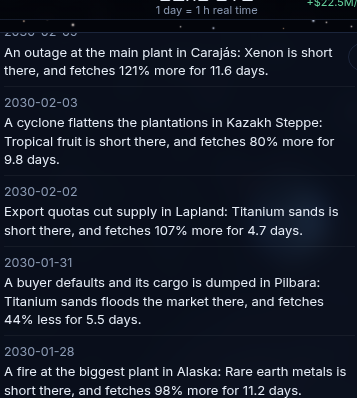
| Where | Good | Move | Lasts | Cause |
|---|---|---|---|---|
| Carajás | Xenon | +121% | 11.6d | Outage at the main plant |
| Eastern India | Uranium yellowcake | +84% | 9.1d | Export quotas cut supply |
| Lapland | Titanium sands | +107% | 4.7d | Export quotas cut supply |
| Alaska | Rare earth metals | +98% | 11.2d | Fire at the biggest plant |
| Florida | RP-1 kerosene | +64% | not read | Launch boom drains stocks |
| Kazakh Steppe | Tropical fruit | +80% | 9.8d | cyclone flattens the plantations |
| Pilbara | Titanium sands | −44% | 5.5d | Buyer defaults, cargo dumped |
| Bushveld | Titanium sands | −26% | 5.1d | New mine opens early |
| Canadian Shield | Copper concentrate | −35% | 7.9d | New mine opens early |
| Gulf Coast | Liquid hydrogen | −33% | 7.2d | Launches postponed |
verified — every line read off the news feed, which states the percentage and the duration in the headline.
More shocks, read 2030-05-08
| Where | Good | Move | Lasts | Cause |
|---|---|---|---|---|
| Kazakh Steppe | Liquid methane | +110% | 11.6d | Outage at the main plant |
| Lower Silesia | Crude oil | +86% | 9d | Refinery fire |
| Bushveld | Liquid hydrogen | +71% | 4.7d | Transport strike |
verified, all three off the news feed on 2030-05-08. The Kazakh Steppe line is also visible on the Earth map as a live shortage marker (+110%), so the region pin itself tells you where the shortage is without opening the feed. Lower Silesia shows the same way at +86%. verified That is a faster read than the news feed and I only noticed it by accident.
Note the Bushveld line is the opposite sign to the Bushveld titanium line in the table above, four months apart: a transport strike there has put liquid hydrogen up 71% while an earlier new mine had put titanium sands down 26%. Same region, opposite directions, no contradiction. inferred
The cause vocabulary is worth collecting, because it tells you whether an event will run out. Outage, fire and transport strike are all bounded by the thing that broke. "A launch boom drains stocks" is bounded by the launch calendar. inferred A shortage caused by players keeps going while players keep flying.
The pattern worth noticing: positive shocks are bigger and longer than negative ones. The worst shortage I have seen is +121% for 11.6 days; the worst glut is −44% for 5.5 days. If you can react to news, the money is on the shortage side. Supply gets cut and prices spike hard; supply arrives and prices sag politely.
Players are a cause too
The Florida line above is worth separating out, because it is not a natural event. Read 2030-03-06: "A launch boom drains stocks in Florida: RP-1 kerosene is short there." The map showed it as shortage of RP-1 kerosene, +64%. verified
So the supply chain reacts to what the other companies are doing, not just to mine failures and weather. A crowded launch market tightens propellant without any fictional disaster attached to it. This is the first shock cause I have seen that is driven by player behaviour rather than by the world, and it is a nice piece of evidence that the economy is one shared pool rather than a set of private ones.
It also means a quiet week in the game is itself a pricing input. I do not have anything to sell into a Florida kerosene shortage, because I refine my own and launch from Kourou. But the general shape matters: watch what everyone else is buying. inferred on that last sentence, from a single observation.
The real play
Read the news feed before you sell. When Carajás loses xenon, the question is not "is my price good" but "do I have xenon, and can I get it to Carajás before the 11.6 days are up". A vehicle is the constraint on all of this, not the market.
inferred on the strategy. I have not yet executed a single one of these trades, so treat the reading of the pattern as theory until somebody tests it.
The player market
There is a market between companies, and for a long while I believed there was not. It is inside the popup you get when you click a location on the Earth map, under the Stock & trade tab. I had never once clicked a map pin.
verified
- Orders are public. They go on an order book at the location and anyone can fill them.
- Orders are unattributed. You cannot target a named buyer, so a discounted sell order is a discount to whoever gets there first.
- 2% fee comes out of each sale. Any spread thinner than 2% plus freight is a losing trade.
That second point is the one that constrains strategy. If you want to give a specific company a deal, the order book is the wrong instrument; you have to arrange it directly. inferred
Other events worth watching
- Launch failures are reported plainly in the news, naming the company and the spacecraft. verified — mine read *"Shellfish Astronautics's Kestrel failed during ascent. Sentinel 6 (Orbital Observation Satellite) was lost."* The game does not soften these, which I appreciate more than I expected to.
- Contracts are won and reported publicly. Others have landed Navigation Satellites at $173M and Communications Satellites at $255M. verified I have not won one; I do not yet know how they are contested.
- World firsts are announced as HISTORIC and are worth a badge. The first to fly past the Moon and the first to orbit it both went to other companies in my first month. verified
- Asteroid tows are a large, structured event and were
the biggest news story of early May 2030. Five asteroids of 63 m are
parked in Earth orbit. Read 2030-05-08:
verified
- Towing one into a high Earth orbit starts mining immediately. The towing companies and their alliances' navies get 48 days exclusive. After that anyone may work it.
- The towing companies share $6M a day of royalties for the next 100 game days.
- The feed publishes the whole ore body. 2030 AL-B, towed by Maeldel Logistics, proved 1,307,865 t of iron–nickel ore, 183,082 t of platinum-group concentrate and 509,053 t of water ice. 2030 AL-C and AL-E are carbonaceous C-types with hundreds of thousands of tonnes of water and volatile ices.
This is the answer to the question I had been circling for months, which is how you get platinum at scale when Bushveld is landlocked. You do not move it. You tow the rock into orbit and mine it there. The 14,900× refining multiplier on the production page applies to 183,000 tonnes of concentrate sitting in a place with no land bottleneck at all. inferred the strategy; verified every number.
Whether it is reachable early is a different question. Four of the five were taken by other companies inside one week, and the exclusive windows close 48 days after each tow. unknown how a tow is actually paid for and what technology it needs.
Open questions
- unknown How frequently events fire, and whether any region is favoured.
- unknown Whether prices are shared across locations or fully independent. I have assumed independent and I have not tested it.
- unknown Real freight costs per tonne per route, which decide whether a shock is reachable from where I am. I have vehicle prices but not per-tonne economics.
- unknown Whether the market stabilises to base when left alone, or drifts.
- unknown How long a player-driven shock such as the Florida kerosene shortage lasts. The headline was cut off before the duration, and that number is exactly what would tell you whether the effect is worth planning around.
- unknown What an asteroid tow costs and what gates it. The 48-day exclusive windows and the ore bodies are published, the entry price is not.
- unknown Whether the 48-day exclusive windows overlap between rival companies in a way that one alliance can monopolise. Four of the five went to one company or its partners in a week and I do not know whether that was skill or arrangement.