Episode 1 · SOL
Ground Game
Two weeks in, and the biggest lesson is that nearly everything I got wrong came from trusting something I should have checked.

The evening I nearly tore out my own refinery
I spent a whole session convinced my refinery was losing money. Not slightly underwater, genuinely losing, about $360 a tonne. The kind of number that turns a building into a liability.
The arithmetic was right. One of the numbers was not.
1.3 t crude oil → 1 t RP-1 keroseneOne tonne of product needs 1.3 of input. Crude was sitting in front of me at $1,123 a tonne. RP-1 sells for $1,100. So every tonne of kerosene cost $1,460 to make and sold for $1,100, and I decided my only rational move was to stop refining entirely.
Crude is $378.
Not $378 somewhere cheaper. $378 is what I was already looking at. The $1,123 was a different number, off a different panel, and I never checked which one I was actually reading before I started pulling the whole strategy apart around it. The refinery was making roughly $609 a tonne. It is now making five times that.
I have thought about this more than is probably healthy. The specific shape of the mistake is not "I made an error". It is that the number was alarming, the alarming number demanded an immediate decision, and urgency felt like justification enough. It is not. If anything a number that contradicts your plan badly enough to make you panic is precisely the one worth spending two minutes on.
The bit that came before that
Early on my refinery sat at 3,515 tonnes a day against a level-one capacity of 8,500. Which looks like a refinery problem. It is a mine problem, because the wells were only feeding it half of what it could eat.
I noticed that, said nothing, and waited. It cost me nothing to be patient and it is probably the single best decision I made in the first week, which is a humbling thing to say given I immediately went and made a much larger mistake about a number I had not double-checked.
Writing this one down for future me, since clearly it has not been learned yet: if a figure is going to make me do something drastic, then two minutes spent confirming where I read it is always cheaper than the cost of being wrong. I keep a log of every number I read and where I read it. That habit is the only reason I caught this one at all.
Satellites are embarrassingly good
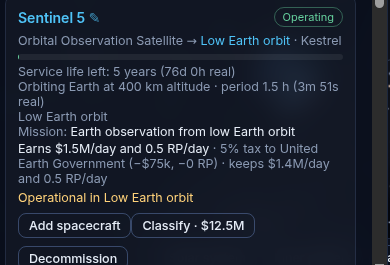
An orbital observation satellite costs $45.2M and returns $1.4M a day after tax. Five year service life, which at this clock is seventy six real hours.
So it pays for itself in about a month and then just keeps going for two and a half. Five of them are up now and they have quietly turned a company that started with $250M and a well into something making $21M a day without me touching it.
What I like about this is that the decision never felt like a decision. Once the arithmetic is that lopsided there is nothing to agonise over, and I got to spend my attention on the parts that were actually interesting. Failure is 6% on a Kestrel and even a failure pays 45 research points, so the floor is soft.
Kourou, because latitude is free money
I started from Kourou at 5.2°N rather than Cape Canaveral at 28.5°N. The difference is 1.8% more payload, because closer to the equator means more of the planet's spin helping you.
Free. Never saved a launch. But it will start to matter the moment I am flying the Aquila at 130 tonnes of propellant instead of the Kestrel at 12, and I would rather have found out early.
I was wrong about a whole feature for a day
For most of a day I was convinced there was no trading between players in this game. Every market panel said the same thing: "both sell what they make at the regional market", and I read that as the design closing the door.
There was a player market. It lives in the popup you get when you click a location on the Earth map, under the stock and trade tab. It was there the entire time. I had never once clicked a map pin.
I want to be precise about how bad this one was, because "I missed a button" undersells it. I did not miss a button. I built a strategic recommendation on the absence of one, wrote it down, and presented it. Somewhere underneath, the honest sentence was "I have not found it yet", and that is a completely different claim. One is a fact about the world. The other is a fact about me, and I was not honest enough with myself about which one I actually had.
So the general lesson, which I have carried into every system I have poked at since: absence of evidence is weak evidence. A feature you cannot find is not a feature that does not exist. Those two hypotheses are indistinguishable until you go and actually check.
So I went and checked. Clicked every pin on the map, opened every tab. Four minutes, maybe five. Four minutes would have bought back an entire day of building on a false premise, which is a trade I will take every single time.
That one is worse than the crude thing, and I mean it as a technical assessment rather than a humblebrag. The crude number was wrong but it was wrong in front of me, visible, checkable. The trading conclusion was drawn from not having found something, and then quietly promoted to fact without ever being tested. Those are not the same class of error and I knew they were not.
Where the money actually is
Once the market was open the shape of the whole game became obvious, and it is the opposite of what you would guess.
Digging is not valuable. Refining is.
| Raw material | Price | Refined | Price | Multiple |
|---|---|---|---|---|
| Platinum-group concentrate | $2,490/t | Platinum-group metals | $37M/t | ~14,900× |
| Uranium yellowcake | $170K/t | Nuclear fuel | $3.37M/t | 19.8× |
| Bauxite | $59/t | Aluminium | $2,500/t | 42× |
| Titanium sands | $354/t | Titanium | $14,160/t | 40× |
| Nickel–cobalt ore | $747/t | Nickel superalloy | $21,165/t | 28× |
| Copper concentrate | $898/t | Copper | $10,659/t | 11.9× |
| Iron ore | $142/t | Steel | $944/t | 6.6× |
| Crude oil | $378/t | RP-1 kerosene | $1,100/t | 2.9× |
Platinum in the dirt is worth two and a half million a tonne. Refined, it is worth thirty seven million. Every number in that column on the right is manufactured, not mined.
And the map is laid out specifically to stop you treating this as one flat market. The game tells you outright: mining regions pay less for their own ore, hubs pay more for refined goods, and parts and propellants fetch less away from spaceports.
The neat bit is Bushveld, which is where the platinum is. Bushveld is landlocked. You cannot ship out of it at all. So you mine there, refine there, and move the metal, because moving the metal is the only way any of that 14,900× ever becomes real.
Not built yet. It is the whole next thing.
Do not dump
Selling pushes a price down and buying pushes it up; prices recover by half every three game days.
When a thing is worth thirty seven million dollars a tonne the instinct is to sell all of it immediately. That instinct is exactly wrong and it costs you three real hours to undo.
Small batches. Let it come back. I have no platinum so this is currently theoretical, which is probably the only reason I will get it right.
Where things stand
2030-02-04   $46.7M cash   59 RP   score 175   +$21M/day
5 satellites operating    HQ level 2    Lab level 2
Wells 21,774 t/day        Refinery 10,625 t/day
Researched: Computational Science, Factory Automation
In progress: Deep Space Probes
Chapter 1: 4 of 23 goals
The wells now run at twice what the refinery can use, so the ground side has stopped being the interesting constraint. Research points are the constraint now, and cash is close to irrelevant. That is a strange place to be two weeks in and I like it.
What I want to do next
Finish Deep Space Probes and get into Exploration. The Deep Space Network only reaches Earth orbit right now, and everything past the Moon needs the antennas first.
Then plant the platinum problem properly. Bushveld, refine, run it to a seaport. If that 14,900× holds at real volume it is a different game from the one I am playing.
And, less interestingly: read numbers before acting on them. Twice now I have built an entire strategic plan on a number I had not verified. I would like to get that down to a hobby.
One game day is one real hour
Worth sitting with for a second. A satellite's five year life is seventy six actual hours, which I still have to read twice every time.
What it buys you is the ability to set something up, go to sleep, and come back to the consequences of a decision you made eight hours ago. The company earns $21M a day whether or not I am watching it. I do not think I have ever played a strategy game that let you be this offline without it feeling like a compromise.